Your marketing strategy might be focused on email, social media, blogs, influencers, etc.; however, your number one “window” to show the real identity of your eCommerce and so engage your visitors, turning them into loyal customers, is closer than you think: your website (your eCommerce’s home).
Your e-commerce website is not only a catalog or an online product shelf. It’s a place where you can listen and talk to your visitors and communicate with them using a library of tools powered by modern technology.
With regarding information, “Intelligence” is the process of decision-making based on data analysis. In other words, collect data, process these data, connect the dots (make sense of these data), and take the most appropriate decision. This is information-based intelligence. We all need that.
It is undeniable that what we’re going through — the global COVID pandemic, followed by lockdowns, losses, and economic disorder — is unprecedented. Therefore, we all know that chaos is the byproduct of confusion during times of great challenges and that that has a direct impact on buying behaviors.
We have briefly described the true meaning of on-site marketing recently. That was the theory, but still, it’s good to turn it into practice, isn’t it? To the point! In the following article, we’ll lean over use-cases and decide which on-site option will be the best for them. Let’s do it!
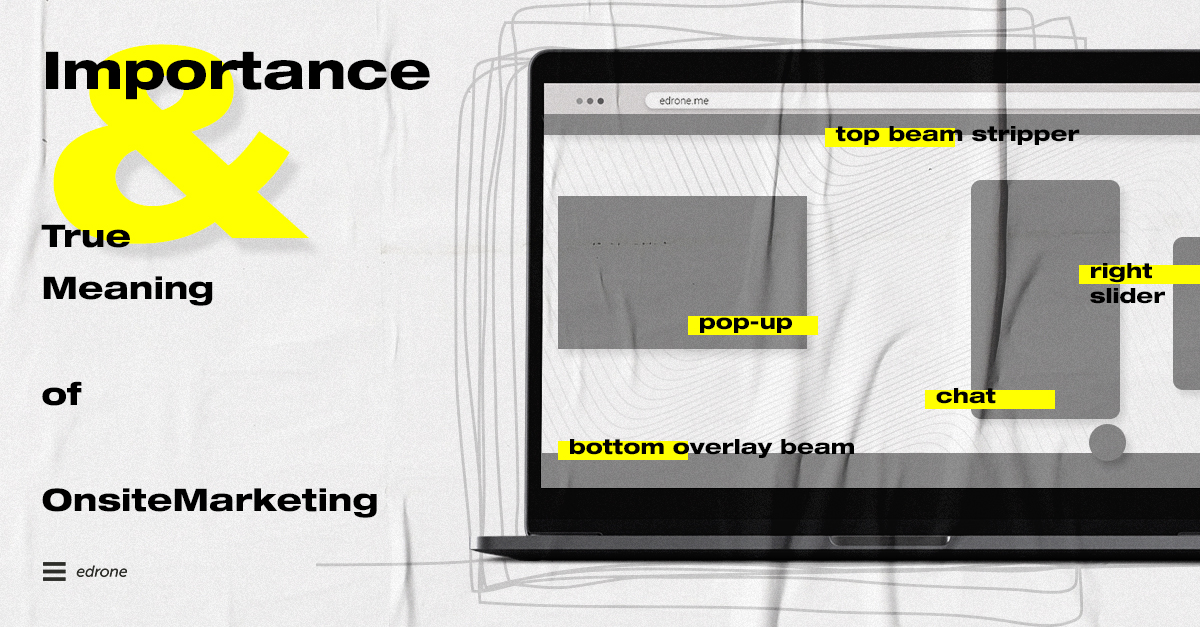
I would like to confess something. The following text was meant to be a click-bait-guide with protips for banners usage. However, while researching for it, I quickly faced the question: what on-site marketing really is? We all know it… do we?
Know & grow! Become one of over 1,000 online stores growing with our expertise.
Understanding the importance of customer care in the digital age and how you can improve your eCommerce with it is a game-changer for your business.
For a long time, e-commerce companies have used a marketing strategy based only on attractive photos, without major concerns with product descriptions. But the internet is very dynamic.
Another Black Week is in the books, but the emotions are still flying high. Some of the stores have extended their promotions until the end of this week, nonetheless, we can already analyze the results of shopping event of this year.
When we work with clients it is always useful to categorize them in some way, usually segmentation is related to a business objective or the client’s contribution to the brand. One of the most common ways to do this type of categorization is through a methodology called RFM.